If your team is still hand-tensioning every strap, there is a good chance the process is costing you more than you realize. Not in obvious ways, but in the slow drain of operator fatigue, inconsistent seals, and a packing line that bottlenecks every time volume spikes.
The good news: you do not need to jump straight to a fully automated conveyor system to fix it.
For most small businesses and growing warehouses, the right upgrade is a semi-automatic strapping machine. It removes the hardest parts of manual strapping without the complexity, footprint, or infrastructure demands of a fully automatic system.
Here is what this guide covers:
Introduction: The Power of the Strap
In the logistics and manufacturing sectors, strapping is the critical process of securing a product, bundle, or pallet by surrounding it with at least two high-tensile bands of plastic or metal. This ensures load stability, prevents theft, and protects goods during the rigors of transport and storage.
As an industrial operation scales, the method of applying these straps must evolve to prevent throughput bottlenecks. We categorize this evolution into three primary levels of automation: manual, semi-automatic, and automatic. Each level represents a significant leap in efficiency, consistency, and safety.
Key Takeaway: The Business Case for Automation Selecting an automation level is a high-stakes ROI decision. Beyond mere speed, the right system reduces "The Hidden Damage Tax" caused by inconsistent tension, mitigates expensive repetitive strain injuries, and optimizes material costs through superior joint efficiency. To master these systems, one must first understand the fundamental manual techniques that serve as the foundation of the industry.
Manual Strapping – The Versatile Foundation
Manual strapping is the most flexible and mobile entry point for packaging. It is technically appropriate for low-volume operations where strapping rates are less than 50 straps per hour or for remote warehouse zones where power-integrated machinery is unavailable.
The Essential Toolset
A manual operator utilizes three core components to secure a load:
- Dispensers: Mobile carts that house coils of strap, preventing tangles and allowing the operator to move the material to the load.
- Tensioners: Handheld mechanical devices that pull the strap to the required tightness.
- Sealers: Tools used to join the overlapping strap ends, typically by crimping a metal seal or “joint” over the material.
Step-by-Step Process
- Wrapping: The operator manually pulls the strap from the dispenser and wraps it around the package or pallet.
- Overlapping: The strap ends are brought together, ensuring they overlap correctly for the sealing tool.
- Tensioning and Sealing: The operator uses the tensioner to cinch the strap until snug, applies a metal seal with the sealer tool, and trims the excess material.
While highly versatile, manual methods are labor-intensive and provide the lowest joint efficiency. As volume demand increases, operations must transition toward mechanical assistance.
Semi-Automatic Strapping – The Tabletop Hybrid
Often referred to as a “Strapping Table,” this level introduces mechanical power to the tensioning and sealing phases while keeping the operator in control of package positioning.
The “Unlimited Volume” Advantage
Unlike higher-level automatic machines, tabletop units do not have a restrictive “arch.” This provides a unique consultant-level advantage: unlimited strapping volumes. As long as the package is at least 10 cm wide (the minimum width required to cover the heater blade), the machine can strap items of virtually any height or length.
Triggered by a button or foot pedal, the machine performs these actions:
- Automatic Tensioning: Cinches the strap to a precise, pre-set tightness, eliminating human error.
- Heat Sealing: Uses a heater blade to melt strap ends together, removing the need for costly metal seals.
- Cutting & Pre-feeding: Severs the finished strap and automatically feeds a fresh length for the next cycle.
| Operator Actions | Machine Actions |
|---|---|
| Positions package on the tabletop. | Automatically tightens strap to pre-set tension. |
| Manually loops the strap over the goods. | Uses a heater blade to create a permanent seal. |
| Feeds strap end into the machine slot. | Cuts the strap and pre-feeds the next loop. |
When throughput requirements exceed the capabilities of a single operator’s hands, the industry moves toward the “Hands-Free” arch standard.
Fully Automatic Strapping – The Hands-Free Standard
Fully automatic systems utilize a built-in Arch and are frequently integrated into conveyor lines. By using photocells and sensors, these machines detect the package and execute the strapping cycle with minimal operator intervention.
Advanced Features & Friction Welding
At this level, the technology shifts from simple heater blades to high-performance Friction Welding. This method achieves 80–85% joint efficiency (compared to only 60% for manual metal seals). This increased strength allows for “down-gauging”—using thinner, less expensive straps without compromising load security.
The “Hands-Free” Workflow
- Detection: Sensors identify the incoming package and stop it precisely under the arch.
- Application: The strap is automatically shot through a pre-sized arch loop (e.g., 850mm x 650mm) surrounding the package.
- Execution: The machine applies tension using a “No Package, No Tension” logic, a safety system that prevents the machine from firing if a package is absent, thereby preventing jams and material waste.
- Maintenance Minimization:
- Auto-Feed: Threads new coils automatically to minimize changeover downtime.
- Jam-Free Re-feed: Automatically clears misfeeds and resets the machine.
- Loop Ejection: Discharges empty loops if the machine is triggered accidentally.
- Last Strap Ejection: Clears the end of a coil to prepare for the next roll.
Comparative Analysis: Efficiency, Volume, and Value
Choosing the right machine requires an honest assessment of throughput and the “Total Cost of Ownership.”
|
Automation Level |
Speed (Straps/Min) |
Key Advantage | Primary Constraint |
|---|---|---|---|
| Manual | 10–15 | Total mobility; low entry cost. | High labor cost; 60% joint efficiency. |
| Semi-Auto | 15–30 | Unlimited package height/length. | Minimum 10cm width required. |
| Fully Auto | 40–65+ | 80–85% joint efficiency; Hands-free. | Fixed arch dimensions limit load size. |
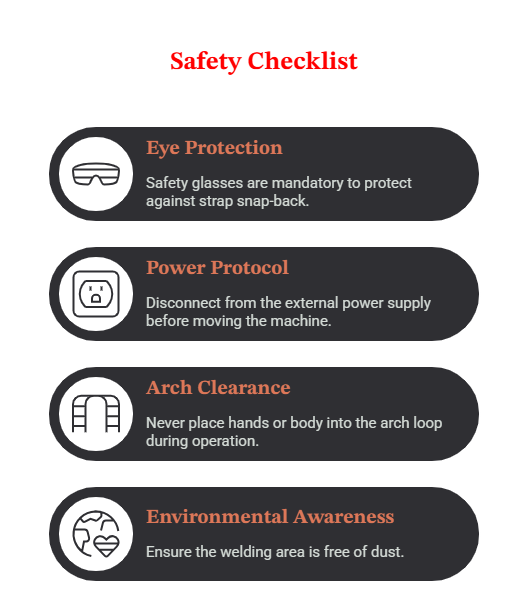
The Learner’s Toolkit: Material & Safety Essentials
Effective automation requires matching the hardware to the correct material.
Technical Material Profile
- Polypropylene (PP): Economical and flexible; ideal for light loads (<350kg).
- Extruded Polyester (PET): High strength and tension recovery; the gold standard for heavy or “settling” loads like lumber.
- Metal: Maximum rigidity; required for sharp-edged, heavy loads (steel/concrete) that do not compress.
- Spun Polyester: A tear-resistant textile strap; best for protecting fragile or high-finish surfaces.
Summary: Selecting the Right Path
To align your equipment with your business goals, utilize this volume-based decision framework:
- Low Demand: Manual Tools. Prioritize mobility and low capital expenditure.
- Moderate Demand: Semi-Automatic/Tabletop. Choose this to clear bottlenecks while maintaining the flexibility to strap unlimited package sizes.
- High Demand: Fully Automatic Arch Systems. This level is essential for high-speed lines where labor savings and material down-gauging drive the fastest ROI.
The transition from hand-tensioning to hands-free operation is more than an upgrade. it is a strategic move that allows a business to scale with precision and safety.